

Someone printed $46,000,000,000 of fake BTC and walked away with $336k
Blockaid’s ~$46.1B face mint and a ~$336k Uniswap cash-out are different numbers. Liquidity, not the raw mint, capped what left as WBTC.

The $46.1B figure is Blockaid’s stated face value on a ~46.12 billion syBTC mint priced near $1 per token. The cash-out was pool depth: about 4.39 WBTC (~$336k–$339k).
Symbiosis halted Bitcoin routing on September 11 after BridgeV2 accepted an abnormal signed receive and minted a synthetic BTC balance far larger than any pool could absorb. Monitors and one Uniswap V4 sale we opened put realized cash-out near 4.39 WBTC. A headline face-value mint and a liquidity-capped cash-out are different numbers. Holders and LPs need three separate recovery tests before treating a reopen notice as closure.
What monitors reported, and what we opened
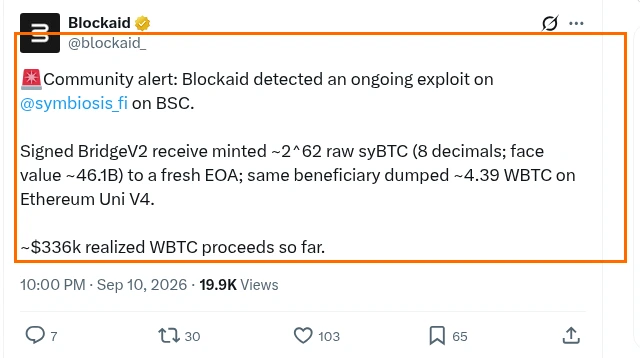
Blockaid’s September 10, 2026 community alert said a signed BridgeV2 receive on BNB Smart Chain minted about 2^62 raw syBTC units to a newly created address. Written out: 2^62 = 4,611,686,018,427,387,904 raw units. At eight decimals, that is 2^62 / 10^8 ≈ 46.12 billion syBTC tokens. Blockaid also stated a face value of roughly $46.1B for that mint. That dollar figure is Blockaid’s face convention, not an independent Block Magnates valuation: it prices the printed tokens near $1 each (an oracle or USD face convention), not 46.1 billion bitcoin of locked BTC, and we did not independently mark syBTC to market.
The same beneficiary path then sold syBTC for about 4.39 WBTC through Uniswap V4 on Ethereum, realizing roughly $336,000 in monitor language. Symbiosis, as reported by Gate, Cryptopolitan, and Lookonchain, said it saw the Bitcoin Bridge attack around 04:28 UTC on September 11 and stopped BTC routing. Other routes, including EVM chains, TRON, TON and components such as Octopools, were described as still running.
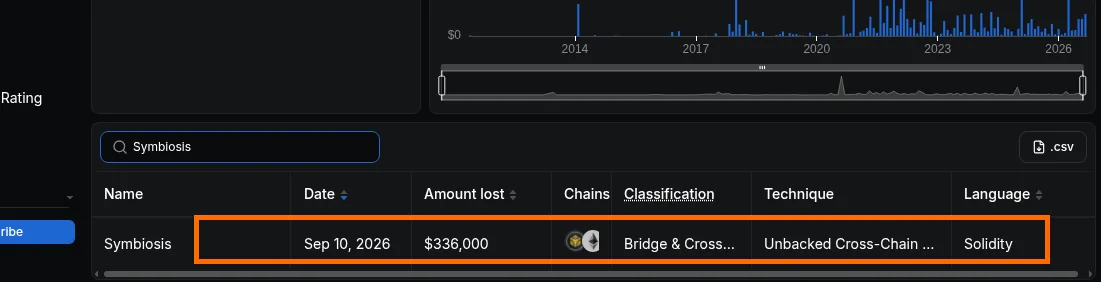
DeFiLlama’s hacks record lists the incident under classification “Bridge & Cross-Chain,” technique Unbacked Cross-Chain Mint, amount 336000, on BSC and Ethereum. That amount tracks the reported cash-out class, not the face value of the mint.
Crypto Times separately cited DefraudTG for a higher multi-chain tally of about 368.9 billion syBTC after several bridge transactions, with a large remainder still on BNB Chain. Those monitors have not published a reconciled counting method in the coverage we opened.
Reconcile the tallies in one place:
- Blockaid (one cited receive): 2^62 raw ≈ 46.12 billion syBTC; face ~$46.1B at ~$1/token (Blockaid’s stated face, not BM’s mark).
- Uniswap V4 sale we opened: Etherscan transaction
0x907a0b0dd5b4b0bbec1130341b81b531635ab89903576399d0a0945ba4962bc6(Sep 11, 2026, 04:35:23 UTC) shows address0x025122b60470EEe9e7947fbD922FE0d35F5d3Ba2sending about 184.47 billion syBTC into Uniswap V4 Pool Manager and receiving about 4.389 WBTC (~$339k at the explorer’s contemporaneous mark). - DefraudTG (via Crypto Times): ~368.9 billion syBTC multi-tx tally — unresolved versus Blockaid until each BNB mint hash is published.
The Uniswap transfer size is larger than Blockaid’s single 2^62 mint figure. That is why monitor tallies still disagree, and why mint hashes on BNB Smart Chain remain the missing primary for a full supply audit.
Why a vast mint is not the loss
syBTC is meant to represent bitcoin locked for cross-chain use. Symbiosis documentation describes a mint-burn path: Portal locks assets on one chain; Synthesis mints synthetic tokens on another; burning reverses the flow. An unauthorized mint creates a synthetic liability without matching locked BTC.
That liability only becomes a cash loss when someone exchanges it for assets that already exist: WBTC in a pool, or redeemable reserves. Evidence for a liquidity-capped drain in this incident is stronger than a single narrative claim, but it is still not a full multi-venue pool audit:
- Blockaid’s alert put realized cash-out near 4.39 WBTC / ~$336k.
- DeFiLlama’s amount field is $336,000 for the Symbiosis entry.
- The Etherscan Uniswap V4 transaction above shows ~4.389 WBTC leaving that pool against a huge syBTC transfer.
Together those sources support the claim that this opened cash-out path was capped by available WBTC in that pool, not by the face value of printed syBTC. We did not independently measure depth across every venue that could accept syBTC. The rest of the unbacked supply remains an accounting and trust problem until it is burned, isolated, or otherwise neutralized on-chain.
So three quantities stay distinct:
- Raw mint (Blockaid, one cited receive): ≈ 46.12 billion syBTC; face ~$46.1B is Blockaid’s ~$1/token nominal.
- Realized cash-out (opened on Etherscan + aligned monitors): ~4.389 WBTC / ~$336k–$339k.
- Final protocol loss: still TBD in Symbiosis updates as of September 12 reporting, after a stated recovery of about 15 BTC.
Where message auth sits in BridgeV2
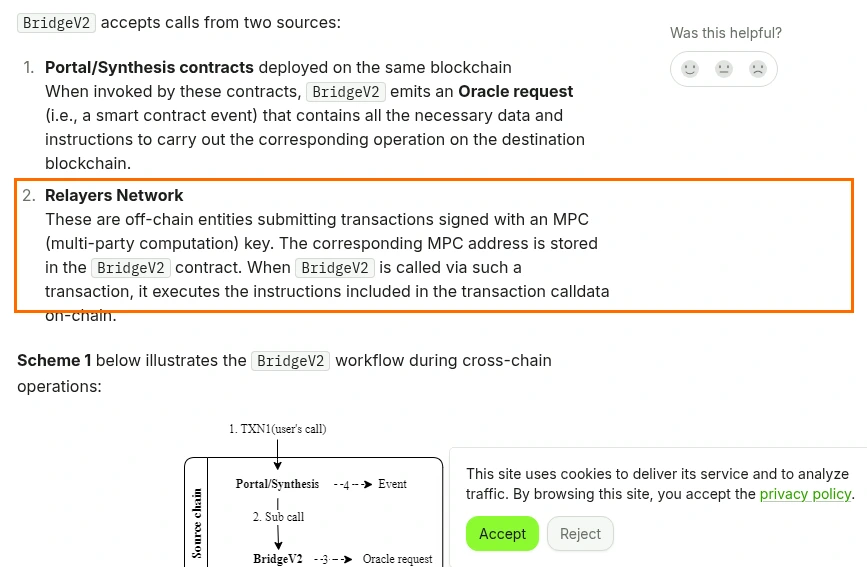
Symbiosis docs place BridgeV2 between the off-chain Relayers Network and the on-chain Portal or Synthesis contracts. Relayers submit transactions signed with an MPC key whose address is stored in BridgeV2. When that path is accepted, the contract executes the calldata instructions, including mint-side work.
The public reporting describes an abnormal signed receive that the contract accepted. That points at message authentication and receive validation, not at Bitcoin’s base-layer consensus.
A software repair has to show that signed receive payloads can no longer authorize mints that do not correspond to valid locked BTC and authenticated cross-chain instructions. A press line that “a patch is underway” is not that evidence.
Three recovery tests, with dated evidence
BTC routes paused while other routes stayed open. That split is useful only if reopen criteria are equally split.
| Test | Dated evidence (as of Sep 12, 2026) | What to look for next |
|---|---|---|
| 1. Software / message-auth repair | Secondary reports say the BridgeV2 vulnerability is being addressed; no public postmortem or release notes opened in this pass that bind the failure to a merged fix and deployment. | Dated release or postmortem: what the abnormal receive allowed, what checks were added, where deployed, and whether unbacked syBTC can still move. |
| 2. BTC route reopen with scope | Symbiosis, as reported by Gate, Cryptopolitan and Lookonchain, halted BTC routing ~04:28 UTC Sep 11; other routes remained open. | A dated notice naming which BTC routes reopen, any caps or queues, and confirmation that message-auth controls are live on those paths. |
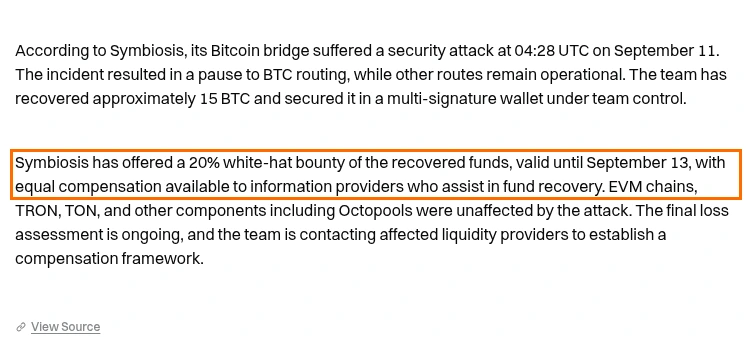
| 3. LP compensation / accounting | Gate and related reports cite ~15 BTC recovered into a team multisig and a timed 20% white-hat offer through Sep 13; final loss and LP terms still TBD in those reports. | Final loss figure, disposition of remaining unbacked syBTC, and concrete LP make-whole terms. |
For the same failure class on Liquid, see Liquid’s Bitcoin Recovery Has Three Tests.
Reporting and disclosure: Sources checked September 12, 2026. Face-value mint attributed to Blockaid; cash-out opened on Etherscan and cross-checked to DeFiLlama’s $336,000 amount field. Symbiosis operational claims attributed via Gate and related secondary reports; Symbiosis’s own social wording was not the sole primary for every claim. Research and writing used AI assistance.